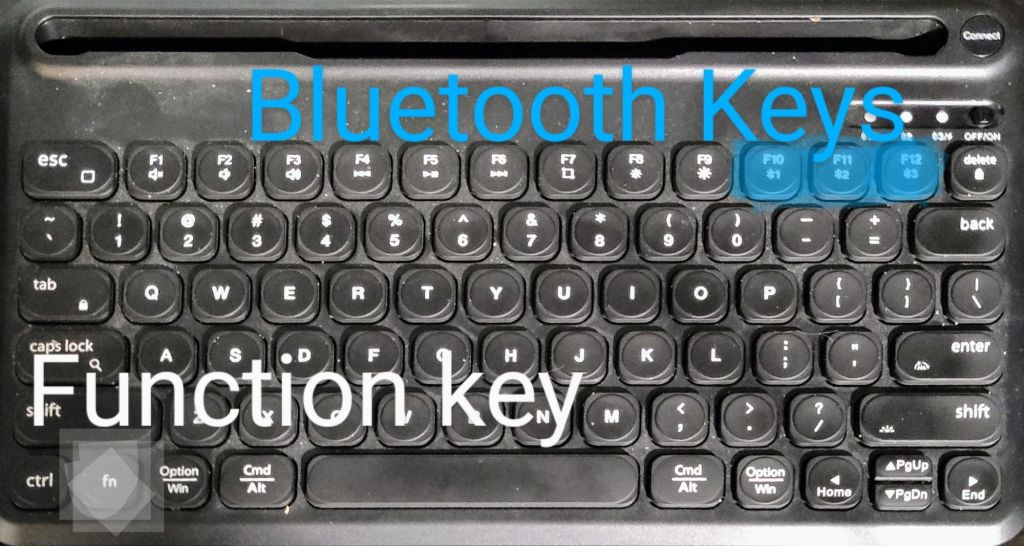
Hold down the function key while pressing the Bluetooth device number you want to use, or program.
Keys Highlighted
Press the connect button on the upper right to pair with device/computer. The appropriate light will flash blue.
Enter the Bluetooth device menu in the settings of your device/computer to complete pairing.
The third light will flash red when low on power. Charge with USB-C cable. The backlight for the keyboard will not function while charging, but the keyboard works normally otherwise.
The F1-F12 keys may not have the defaults you expect. Use the function key (fn) to use the alternate function.
I have used Windows 98 in all the ways mentioned. Which method is best for you, depends on your situation.
Virtual Machine
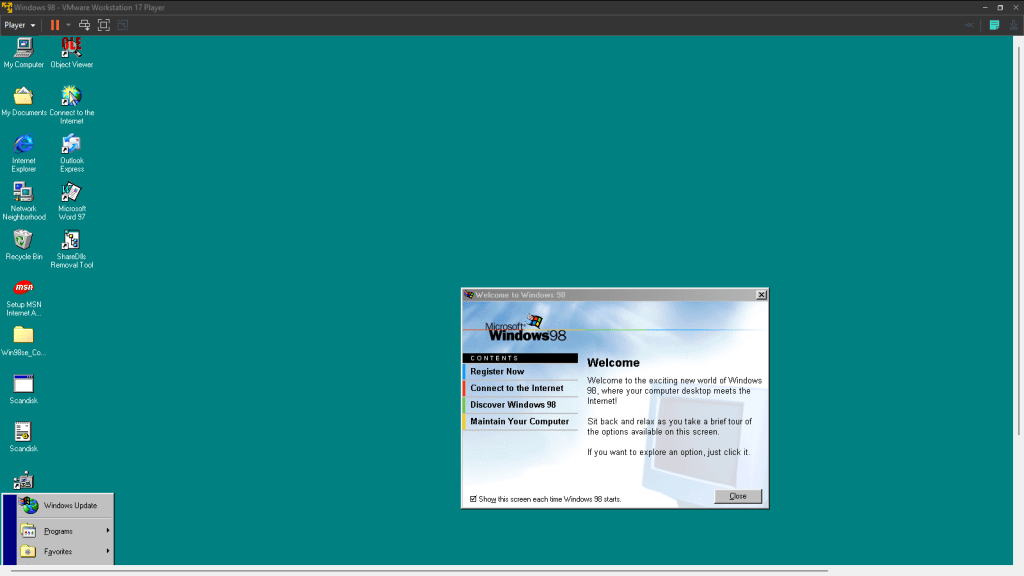
Windows 98 running poorly on VMWare Workstation 17 Player
To my knowledge no virtual machine runs Windows 98 or Windows 95 well, without emulation. It can be done, however. VM Ware and Virtualbox seem to be the most attempted.
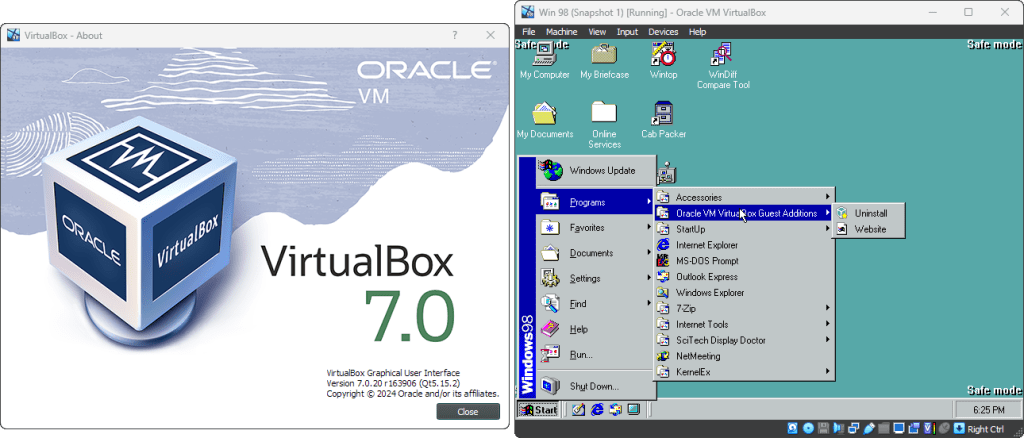
Windows 98 running in safe mode on Virtualbox 7.0.20
Neither VM Ware nor VirtualBox typically support MIDI or Windows 98 display requirements without significant effort. A midi emulator can be enabled in VM Ware and Windows 95 has a working display driver. Neither directly solve the problems, and both are some trouble to setup.
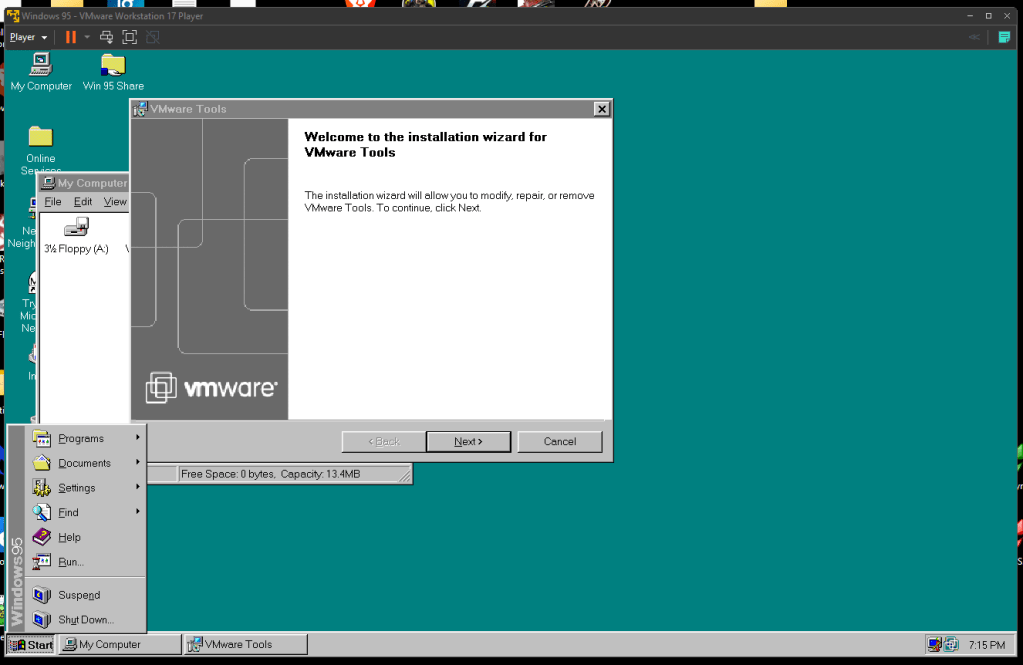
Windows 95 working very well in VM Ware Workstation Player 17
Emulation
I have all of these emulation options set up at home. I strongly prefer 86Box.
86Box
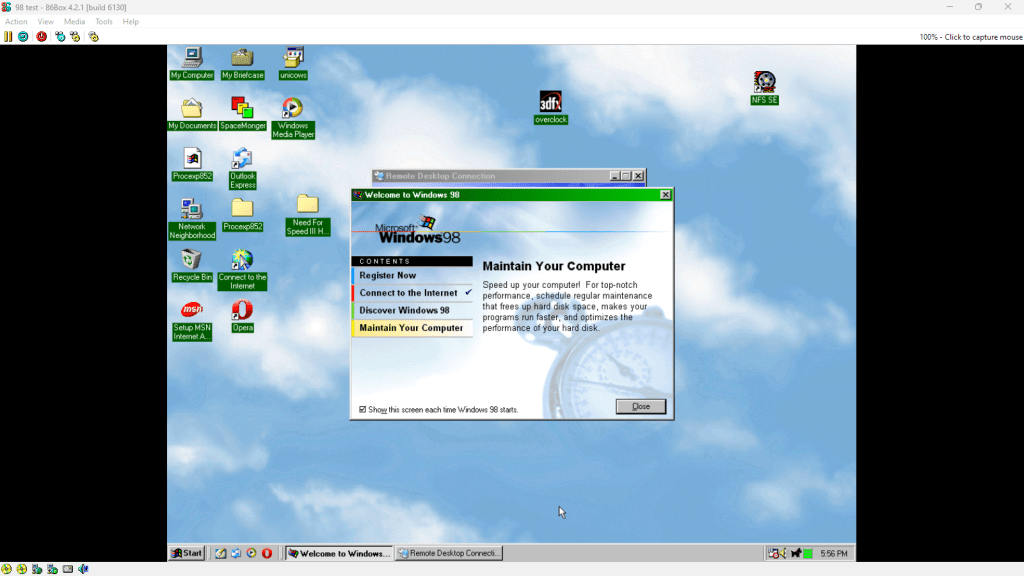
Windows 98 Running in 86Box
The most accurate emulation available is probably 86Box. 86Box attempts to fully emulate the original hardware. This is especially useful for software development, and for very picky old programs. Other options can run faster, though.
Do to the poor performance of full emulation, I recommend emulating:
Pentium or Pentium MMX @ 200Mhz or less.
196MB RAM
Voodoo 2
SoundBlaster 16 (PnP)
you can work on it from there.
QEMU
Windows 98 running on QEMU
QEMU is made to run operating systems designed for almost any type of hardware. It is more focused on speed than 86Box, though.
QEMU can be the most difficult to use, but it can also be the fastest. It runs a lot like a virtual machine. Not limiting the CPU speed, and using “virtual hardware”. So there is much less overhead in emulating peripherals, like sound & video cards.
While a bit difficult to use, DOSBox has decent performance.
DOSBox-X
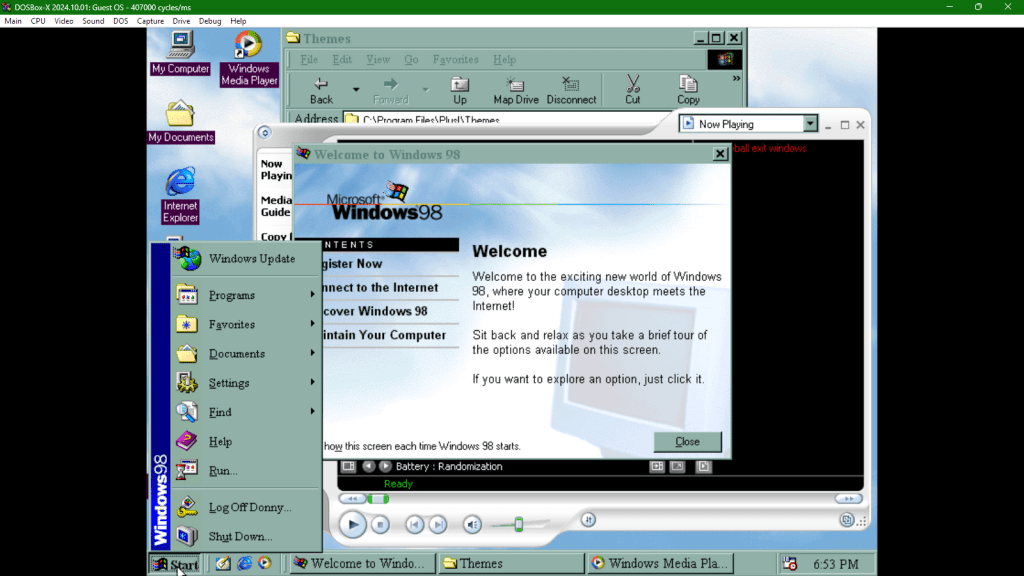
Windows 98 running on DOSBox-X
I personally use DOSBox-X because it is easier to use.
PCem
Windows 98 Running on PCem v17
86Box is derived from PCem. PCem can be faster, and easier to use. It is less accurate though, if that matters to you.
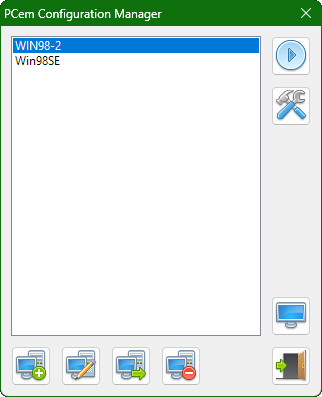
PCem Machine Select Screen
PCem has been abandoned by it’s developer. No new versions are expected. Version 17 from January of 2022 is the last one.
Hardware
CPU & Motherboard/Planar
Windows 98 requires a i486 DX2/66 processor, or better. I would recommend a Pentium MMX or better. Pentium Pro may have some performance issues do to a change in register behavior from then on. Pentium III and Pentium 4 systems often support Windows 98.
While Windows 98 can be forced to run on an i386, this may be unstable. It is certainly undesirable. Socket 775 systems (Core 2) can sometimes run Window 98, but they aren’t usually designed for it.
Video Card
Voodoo2 or Voodoo3 or newer
Sound Card
Sound Blaster 16 (PnP) – Recommended for high compatibility.
Remote Desktop Protocol (RDP) is a Windows NT feature. It is available in most professional & enterprise editions of Windows. This has been the case since Windows XP. The server comes with these editions of Windows. A computer running an RDP server can be connected to by another computer running an RDP client. RDP compatible servers are even available on other operating systems.
This protocol is very good for accessing a Windows desktop remotely. with good equipment even video playback, such as 4k YouTube playback, is possible. RDP is poorly suited for most games and many full-screen and complex 3D applications.
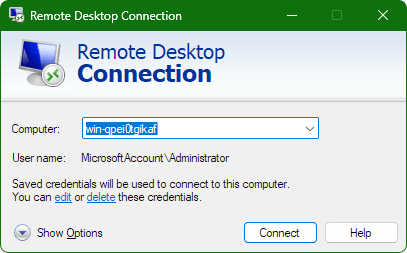
Several clients are available, including FreeRDP, Remmina (based on FreeRDP), and rdesktop. Even home editions of Windows typically include the “Remote Desktop Connection” or similar application, out of the box.
RDP compatible servers exist, that are not made by Microsoft. This includes the open source xrdp.
Virtual Network Computing (VNC) uses the Remote Frame Buffer protocol (RFB). VNC has been optimised for many different operating systems. VNC based programs include Real VNC, Krfb, Libvncserver, PocketVNC, Remmina, TigerVNC, TightVNC, VirtualGL, and Vinagre. Learn more on Wikipedia.
VNC provides similar functionality to RDP and has similar limitations.
Simple Protocol for Independent Computing Environments
Simple Protocol for Independent Computing Environments (SPICE) is a remote viewer for virtual displays in virtual machines. Many clients exist, but the service runs on QEMU and some other KVM hypervisors. Remote access to a virtual machine can be provided globally, from anywhere in the world.
SPICE likely has too much latency in it’s implementation to be effective for video games. VNC and RDP can have better performance.
Moonlight is a remote access client designed for GeForce Experience. This allows the client to receive a low latency continuous video stream from the host device. This low latency facilitates playing video games remotely.
Sunlight is a replacement server for Moonlight clients. It is compatible with many different hardware configurations. It is not GeForce Experience reliant.
Steam Remote Play
Play games installed on your gaming PC from most devices across the house or around the world. Steam Remote Play is one of the most popular remote gaming choices. You can even play local cooperative games with a distant friend. Some games are even compatible with certain VR headsets.






 Donny Cowell